Quantitative research / Software engineering
SMC Intelligent Signal Engine
A provider-independent research platform for causal signal detection, historical replay, simulated execution and reproducible evaluation.
Private research project
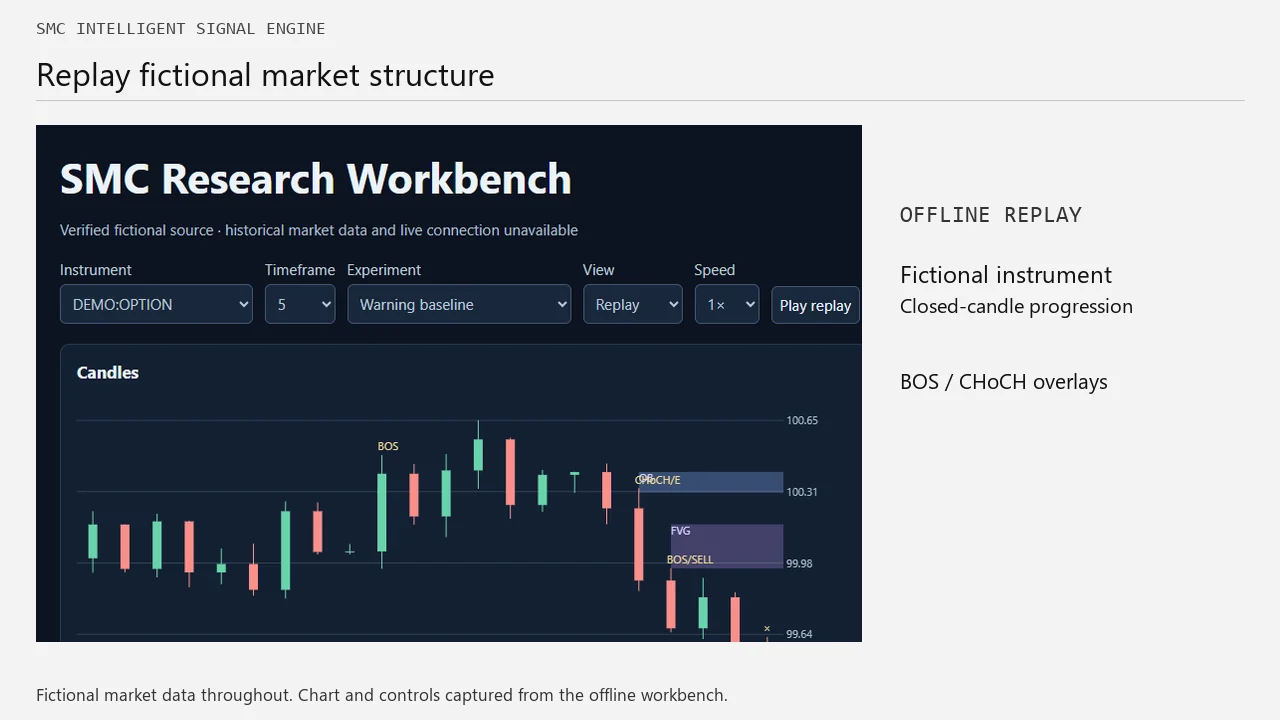
The workbench loads an offline fixture for replay.
The candle cursor exposes only the history available up to that step.
63 regression tests passed. The offline 100-instrument benchmark measured an 87.6% reduction in peak traced engine allocation.
Problem statement
A research replay can silently change past signals if it reads incomplete bars or future observations. Source-specific ingestion also makes it difficult to reproduce results with another dataset.
Engineering objectives
Keep confirmed signals causal and immutable, plug in replaceable data sources and preserve an auditable offline baseline.
Architecture
Provider contracts normalize inputs. Session rules and the tick bucketer feed completed candles into the confirmed engine. Context and warnings run alongside the ledger. SQLite stores experiment metadata and Parquet stores licensed or synthetic history.
- CSV / Parquet or mock ticks
- Session-aware completed candles
- Confirmed ledger + shadow events
- Paper replay / walk-forward evaluation
Implementation
The research workbench exposes candle and tick replay. Structure features include BOS and CHoCH, internal and swing pivots, order blocks, fair value gaps, liquidity pools and higher-timeframe context. The warning lifecycle is recorded separately. Paper execution models next-open entry, gaps and ambiguous stop/target bars.
Technical decisions
Input partitions carry provenance and permission metadata. Walk-forward folds purge overlapping labels and keep final evaluation separate. A fixed history window retains enough bars for the configured pivots and minimum lookback.
Challenges and solutions
Bounded history had to preserve signal payloads exactly. The implementation compares against the frozen baseline across pivot widths and checks that historical and mock-stream inputs agree when their finalized candles and warm-up match.
Automated testing
63 regression tests passed. Chrome exercised workbench controls and cursor-scoped export. The suite checks prefix invariance, session boundaries, historical/mock-stream parity and one-time fictional final-holdout access.
Verified results
- The frozen baseline replay report was reproduced byte for byte.
- At 100 simulated instruments, peak traced engine allocation fell from 342,416 to 42,416 bytes (87.6%). The measurement excludes whole-process and native browser memory.
- Offline p95: 7.2 µs confirmed candle processing, 24.8 µs tick normalization and bucketing, and 3.5 ms visible dashboard update in the documented benchmark.
Limitations
All results use fictional inputs. Genuine predictive accuracy, profitability and broker latency remain unmeasured. Historical and live feeds are disabled pending documented permissions. Execution is simulated.
Future development
Obtain data-use and retention permissions, validate exact dataset partitions and calendar coverage, then evaluate the frozen protocol independently.
Repository information
- Repository
smc-signal-engine- Validated commit
afd99e5- Milestone
- smc-research-ready-v1